Crochet Blankets – from 10 years ago!

WARNING – THIS BLOG POST IS WORD HEAVY!

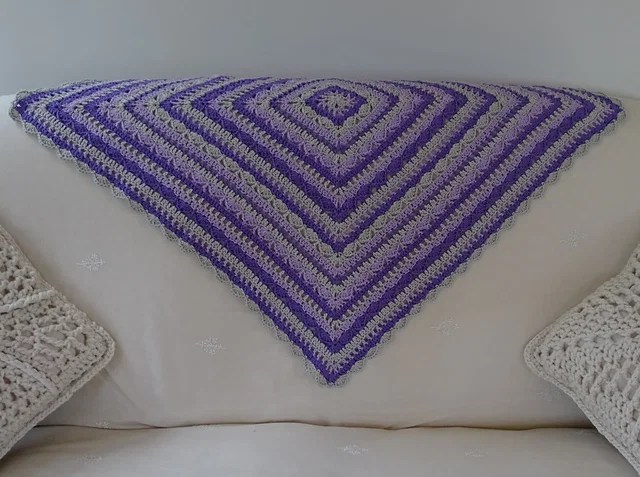
Way back in 2016 I held a workshop at the Cheshire Fibre Festival (I also co-organised the festival!) called Crochet Blankets; Stripes or Squares. I designed 2 blankets for the workshop both using the same stitch pattern, one was a stripe blanket the other a square blanket. They were called Sandlebridge Stripes and Sandlebridge Squares and you can find the patterns on Ravelry (Stripes and Squares) and on LoveCrafts.

Very recently someone made the most lovely comment on the Sandlebridge Squares pattern on Ravelry and it made me recall back to when I designed it. I offered her a copy of the workshop handout notes from 2016 and later that evening I thought ‘why not publish them on my blog?’. So this blog is a reproduction of those notes, although edited slightly to remove some of that workshop specific material.

It is very word heavy, but I’ve thrown in a few photos to break the monotony for you.

In the workshop I encouraged everyone to share their blanket making experiences and it was a lovely 2 hour workshop for me and, I hope, the attendees.
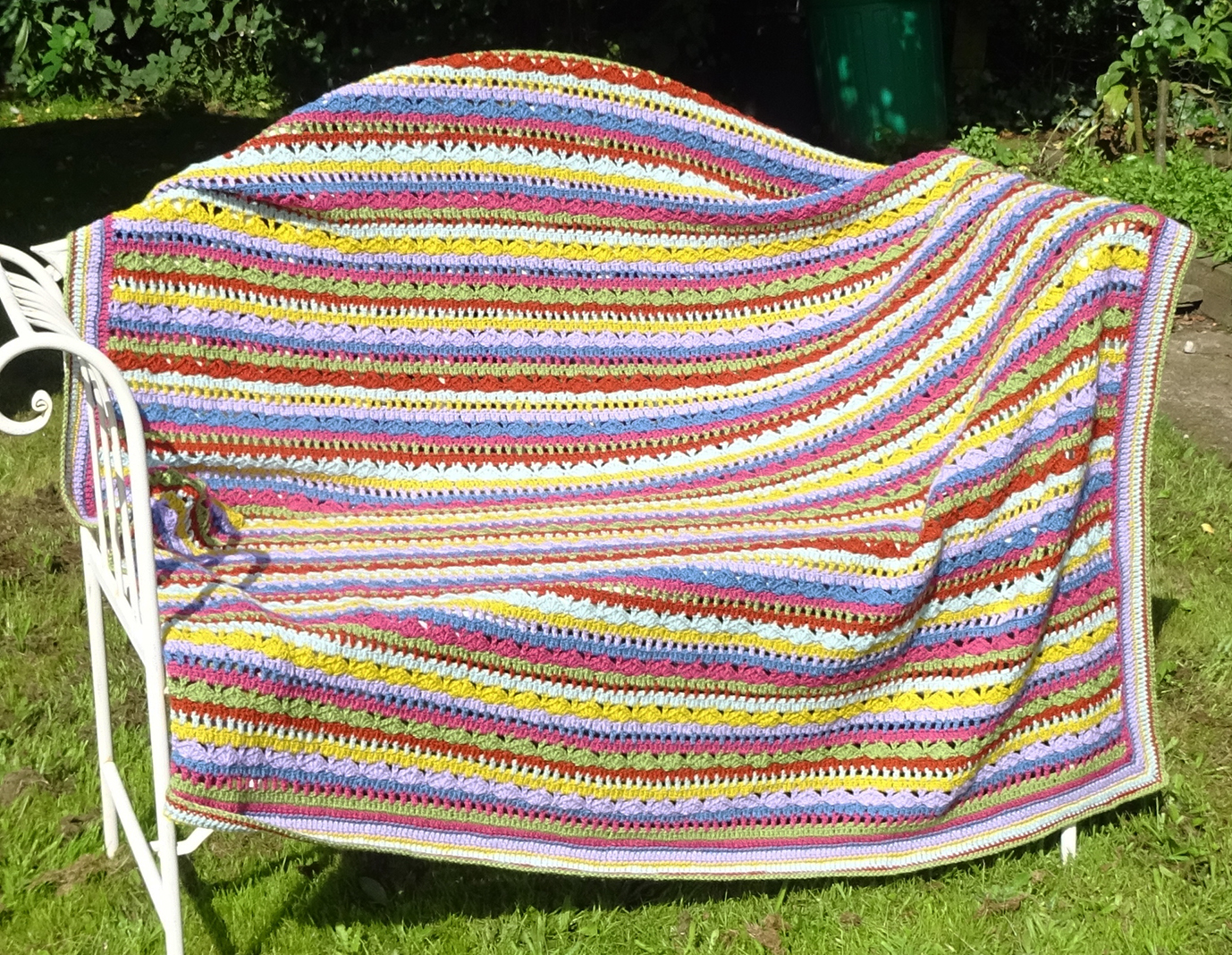
Sandlebridge Stripes

Here it begins:

Introduction

Crochet blankets are pretty, practical and very popular.  If you haven’t yet made one, you’re probably contemplating it.

Traditionally, granny square blankets used to be the most common type of handmade crochet blanket.  However, in the modern world crochet has moved the boundaries on from that tradition and now there is a wide choice of styles to choose from.  But which one is right for you?   It may not be the one you love to look at, because you may find it very tricky to make, or even boring!  But how do you know? 

Crochet blankets are a large investment in time and money, not to mention the space you need to store your project whilst making it.  So this workshop is aimed at showing you the things to consider when choosing your crochet blanket, to help ensure it does not end up hidden in a cupboard half-made, unloved and taking up precious space.

It covers yarn, ease of making and style.  The 3 main styles of blanket are stripes, a large crochet square and lots of smaller crochet squares.  There are other styles but the pros and cons of each style will fall into one of these 3 main categories, for example hexagonal motif blankets will prove similar to small squares blankets.

I’ve designed more than a dozen blankets and made more than double that, so I have significant experience.  And funnily enough, until recently, the vast majority of the blankets I made were made of squares!

I designed 2 blankets, Sandlebridge Stripes and Sandlebridge Square(s) patterns, which are used in the workshop to demonstrate the pros and cons of style, and I included the basic granny square pattern, the basic granny stripe pattern and the basic corner to corner pattern, but not in these notes for the blog.

Crochet Kit

You don’t need anything special to make blankets, just your usual crochet kit which should include hooks, scissors, tapestry needle, solid ruler and lockable stitch markers. But you will need a large project bag or tub, and have a good way of organising your yarn if you are using lots of colours.  And if you’re using stash a set of small scales will be handy for weighing your yarn and how much you are using as you go.

Size

Crochet blankets can be any size you like from a small baby blanket to a huge queen size bed blanket (and larger!).  Here are some typical sizes:

Baby car seat – 40 by 50cm

Baby  – 60 to 70cm square or rectangular

Lap blanket  – from 80cm square

Single bed  – from 1.1m to 1.3m wide by 1.7m to 2m long

Double bed – from 1.45m to 1.6m wide by 1.7m to 2m long

King size bed – from 1.6m to 1.8m wide by 1.9m to 2.2m long

Yarn

You could use absolutely any yarn, either in base quality (eg merino, silk, acrylic) or thickness (4 ply, dk, aran).  If you are following a pattern then you will be guided, but you may be making a blanket to your own design or even adapting a pattern.  However, the end result may not be right if you don’t select your yarn carefully.

If you consider base quality – what is the blanket to be used for?  

For example, a baby blanket may need to be in a strong yarn, able to withstand wear, plenty of washes and with colour that is fast – acrylic would be good, as would cotton. 

An heirloom blanket, which will be lovingly cared for, with a lovely pattern would benefit from a yarn with good stitch definition, a good quality merino 4 ply may suit. 

And do you want to make it quickly?  If so aran weight, chunky or super chunky would work well.  Just remember the finer the yarn the longer it will take to make.

A good all round yarn is one that washes well, makes up reasonable quickly and has good colourfastness.  And Stylecraft DK is one that is favoured by many – it is good quality and affordable.

Typical quantities of Stylecraft Special DK for blankets:

TypeSizeQuantity (100g balls)
Baby car seat40 x 50cm2
Baby70cm x 70cm3
Lap blanket1m square6
Small bed1.1m by 1.8m12
Double bed1.5m x 1.8m15
King size bed1.8m x 2m20

If you are using several colours, then divide the amount by the number of colours and add a good margin, say 20-25%.

Colour

Colour tends to be personal choice, and that choice is many and varied, but you don’t need to have lots of colour.  A single colour blanket can look stunning.  

There are lots of resources available in books and on the internet about colour theory, which will help you with colour choice.

If you have difficulty choosing then there are lots of colour packs available from yarn suppliers and plenty of designers to take inspiration from.

Style

Some people like stripes, some people like squares.  Which do you like and why?   Or do you have no preference?   Whatever it is, remember that any stitch pattern can be done in a square or in a stripe.   So if you find a stitch pattern you like and it is in stripes, you can adapt it to squares if you want to (and vice versa), it just takes a bit of experience.

Blanket styleProsCons
  Stripes  Rhythm of repetition is soothing and therapeutic.  
Colourwork is also very therapeutic.   Stripes look fantastic!  
For some this repetition can be  boring.   There can be lots of ends to sew   Sewing ends at both sides of the blanket, or in some cases mainly one side of the blanket can make it uneven.  
The edge can be difficult and messy to set up  
The larger it gets the less portable it is  
  Large square  Good rhythm, especially as it gets large. Good opportunity for colour therapy.   The edge takes care of itself  Lots of ends to sew, if using lots of colour  
The larger it gets the less portable it is.
  Small square  Portable (although join as you go squares may not be depending on your joining routine)  
Good opportunity for colour therapy.   The edge is easy to set up, and sometimes not necessary    
Not so good rhythm  
Joining  
Sewing ends  
Unless it’s join as you go, then best to block before joining.  
Sandlebridge Squares

Layout

Layout can be anything you like, and absolutely anything goes.  However, if you want variety in your crochet look for a layout that isn’t all the same – mix and match squares/motifs and stripes.   Some graph paper may help you.
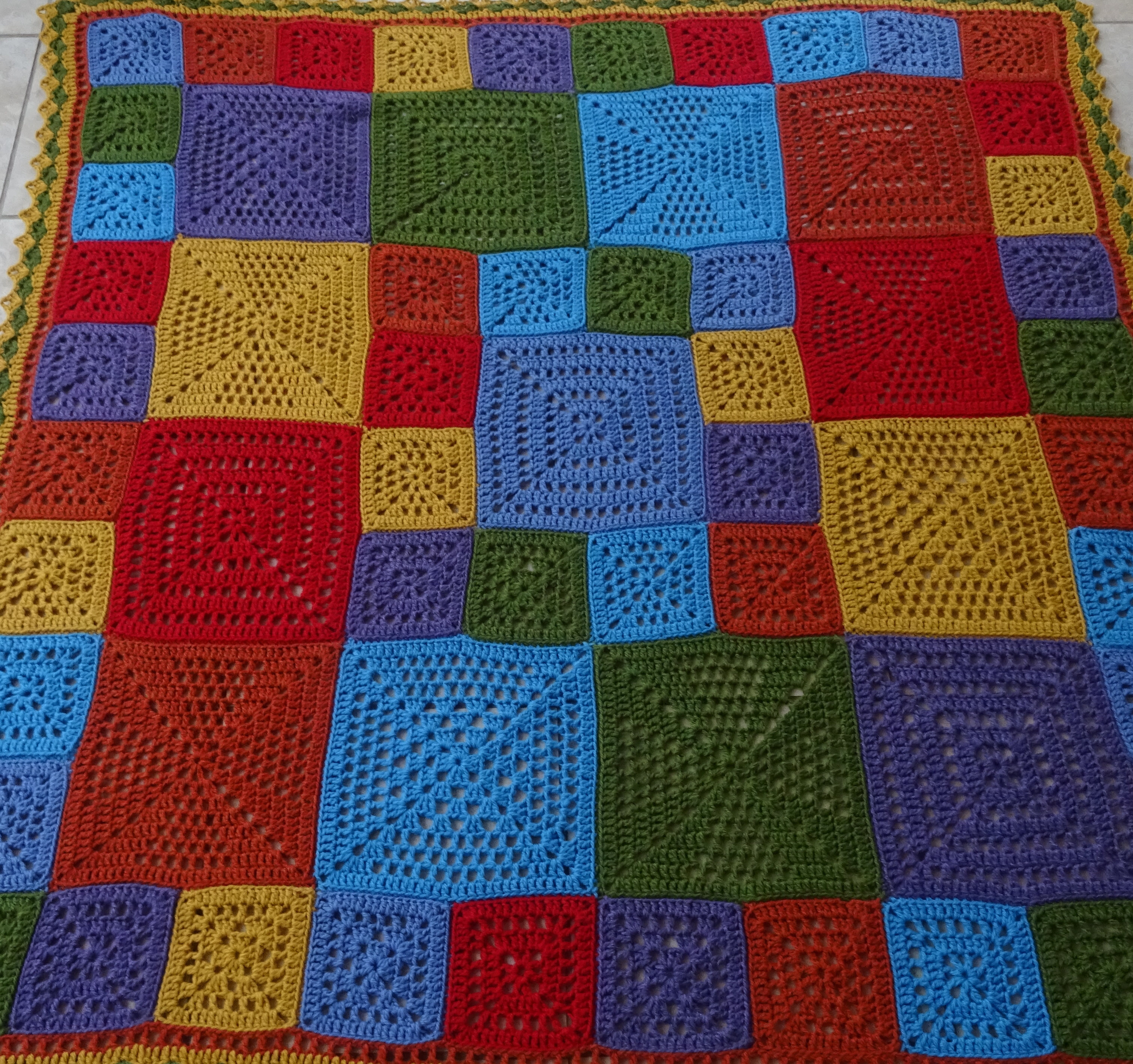
A blanket design from 2015 where I used different sized squares to vary the layout

Ease of pattern

If asked what my choice of easy and quick blanket to make would be, then the answer is simple – in aran weight, a large granny square and in one colour!  This is because aran weight makes up quickly, I find granny squares easy and not as boring as stripes (I have a low boredom threshold) because there are 4 corners to stop and change rhythm, there are fewer ends to sew and the edge takes care of itself.    But this is my choice, I know that I like to make blankets quickly and I know where my boredom threshold lies J

When considering ease of pattern here are a few other things to think of:

The easiest sts to make are in spaces (such as a granny st which works most sts into a 1ch space) – so if you want a quick make or are an inexperienced crocheter, you would use these.  Even a stripey blanket with a repetitive pattern can be made easy with a pattern that works in spaces (such as a granny stripe).

Do you want to crochet quietly and enjoy a challenge?  Or do you want to crochet your blanket in front of the tv, on the train, in the car (as a passenger), at knitgroup? 

These will determine the complexity of the pattern you should try; a complex pattern will require concentration and may prove a challenge – but do something simple in front of the tv (you don’t want to frog often!).

Do you get bored easily?  You need more variety and complex patterns, maybe something that has lots of rows/rounds of pattern rather than the same row/round repeated.

Do you lack crochet confidence?  Aim for a mix of easy and slightly more complex, the easy parts will give you confidence and the slightly more complex parts will stretch you a little.

Remember:  always do a swatch to see whether you like the pattern!

The Edge

The more fancy the blanket pattern, the simpler the edge should be.   But a plain blanket can withstand a very fancy edge or a simple plain edge.

If you have a stripe blanket, try to avoid doing the first round of the edge in the same colour as the first and last row, to avoid the blanket stripes appearing unbalanced.    Also if you are using lots of colours in your blanket but want only a few for the edge, don’t choose them in exactly the same order, take, say, 3 colours from across the range, otherwise you may get a ‘multi-framed’ effect.

Dealing with the edge on stripes – normally pick up 2 sts at the end of tr rows and 1 st at the end of dc rows.  Also, to avoid holes at the side of the stripes, make sts into the row ends NOT around the posts of the row ends.

Joining

There are many ways of joining squares, and they warrant a whole workshop!    Whatever way you decide to join, it is best to trial it first to ensure you are comfortable with the process, you want to be able to join it at the end and if you don’t like the process the blanket may languish unfinished!

Tips and tricks

The ends – Sew your ends as you go because this will give the neatest finish.  With stripes you can even work over them as you start a new colour, but for a solid finish I recommend sewing them a little first before working over them.  If you don’t like sewing ends, change colour less frequently – i.e broader stripes or one colour squares.  Even numbers of rows of one colour will result in all ends at one side of the blanket – so choose odd numbers to even out the ends.

Standing stitches – If you are an experienced crocheter, you may wish to start rows/rounds with new yarn with a standing stitch rather than 3ch, 2ch etc.  This will give a better finish.  

Sewing the last stitch (on rounds or on the edge) – Similarly, you will achieve a better finish if you sew the last part of the last st on a colour change round rather than join the round with a slip stitch.    

Avoiding jogs (on rounds) – To avoid getting a jog (or twist) try starting your rounds in different places and thus also offsetting the location of the ends that you need to sew.

Hook changes – If you want to do a certain st on a row/round and it’s puckering or tightening – just change your hook size – larger to correct tightening and smaller to correct puckering.

Have scales handy – weighing your yarn to see how much a stripe or square uses will help you in identifying whether you have sufficient to finish or maybe just make that blanket a tad larger.

Pace yourself – crochet injuries are rare but too much crocheting can result in tired, arms, wrists, hands, shoulders and back.   But if you have a tight timescale in which to make the blanket, use maths to work out how much you should do each day, and work out whether you can manage that comfortably.

Join as you go squares – If doing small squares that are join as you go, they can be less portable.  But you could work each square up to the last round and join later – or do all rounds without joining and don’t fasten off, instead undo part of the last round and join in a joining session.

I hope you find these notes helpful and they encourage you to maybe be a bit more adventurous in choosing your next blanket project. If you want to see my crochet blanket designs you can find them here.

I also did a workshop on mandalas and those notes may well be published here soon! Until then…….

Happy crocheting xxx

Advent CAL 2023 – part 4

Welcome to day 4 of the Advent CAL 2023 – the 10 Gift Bags of Christmas!

The fourth bag is again based on granny squares and I designed it specifically for a present of a bar of luxury soap (plus a washcloth, oops did I make a present?).   So I called it the Soap Gift Bag. Granny squares are extremely versatile and can be joined together to make a larger shape and 3D shapes.  Small granny squares are also great for using up leftover yarn and are more versatile when creating 3D shapes.  So this is a perfect stashbusting gift bag.

The pattern includes a diagram of how you join the grannies to make the bag. Once you’ve mastered the joining then you could make all shapes of bags with grannies.

The pattern is available here and is free provided you use the code SOAP on purchase.  All the patterns in the CAL will be available free for the duration of the CAL, until midnight GMT 13th December 2023.

I hope you enjoy making this gift bag.  Please share progress on Ravelry, Facebook or instagram.

Until tomorrow, happy crocheting xxx

Granny Square Day 2023

Today (15th August 2023) is Granny Square Day so I thought it the right time to remind you of some of my granny square designs, many of which are free.

First is the Festival Bag with a free pattern on the blog here.

Next there are lots of granny square variations in my Blog Blanket CAL 2015, first blog post here. These are free on the blog but there is also a downloadable pattern on Ravelry for £2.

And my Christmas Blanket 2014 also has granny square variations free on the blog, or again a printable version for £2 on Ravelry.

These are all ‘traditional’ styles of granny square, you can find other square designs of mine on Ravelry here.

Finally, I was having a chat with a good friend today about how I’d love a t-shirt or blouse in granny square fabric. I was so pleased to discover she has some designs available on her website – just have a look here. What a fantastic thing to discover on Granny Square Day!! I may just have ordered a couple of items 🙂

Happy crocheting xxx

Here we go……..

Welcome to the Winter CAL 2015.   Today I’m introducing the CAL, providing information on requirements and the pattern for the first square motif, a ‘solid’ granny which should be pretty familiar and which will help you estimate your own requirements if you aren’t using the same yarn.

This post is rather long, so make a cuppa and settle down for a long read !

YARN

First let’s talk about yarn.  I’m using a double knit (DK) yarn and I’m making 2 blankets.

My first is a ‘sample’ blanket using 6 bright colours which cheer up winter and the second is also a bright colour palate but will be structured differently. I’m using the second colour set to crochet along with you.

Sample yarn:  John Arbon, Knit by Numbers DK, 100% merino, 100g/250m per skein.  2 skeins each of Blue (039), Pink (063), Yellow (052), Green (071) and Purple (029)  and 1 skein of Orange (015).  This is sufficient for a blanket 7 motifs square, so a total of 49 motifs and a small border.

John Arbon Knit by Numbers

CAL yarn: Stylecraft Life DK, 75% acrylic/25% wool, 100g/298m per ball.  I’m using 2 balls each of Teal (2416), Mint (2342), Aqua (2357) and Fern (2311) and 1 ball each of Daffodil (2394), Rose (2301), Melon (2359) and Zing (2356).    The blanket will be 7 motifs square also, the same as the sample, but I will put a larger border on this.

Stylecraft Life DK
Stylecraft Life DK

HOOK

I am using a 4mm crochet hook (US G/6)

MOTIF/TENSION

The motifs are square and each motif is approx. 19cm (just under 8in) square after blocking, using the ‘sample’ yarn.

ADAPTABILITY

You can use any yarn you like, as long as you use a suitable hook size.  And you can make it to any size you like.  It is a perfect stash buster.  Later in this blog I show you how to you estimate your yarn requirements.

COLOUR SCHEME

Some of the motifs in this design work well in just one colour, others work well in up to 5 colours.  So whatever you choose, I recommend you have at least 5 colours of yarn.  I used 6 colours in my sample blanket and I’m using 8 colours in my CAL blanket.

MOTIF DESIGNS AND TIMINGS

There are 8 motif designs, and you can use as many or as few as you like.    The first 2 designs are free and will be published on this blog, so you could use just these 2. The first design is published today, the second design will be published on 26th December.

The other 6 will be published weekly thereafter and will be included in a comprehensive pattern which will be available to buy on Ravelry, it will be published initially on 26th December and updated as each motif is released. Photos of the new motifs will appear on this blog, along with my progress updates.

SIZE

You can make the blanket any size you like.   The lap blanket I am making will be 7 motifs square – a total of 49 motifs.  It will be just over 1.3m/52in square with a small border.

HOW TO WORK OUT YARN REQUIREMENTS

This is an approximate way to work out your yarn requirement.

First make the motif in this blog.  I worked out it uses an average amount of yarn for all the 8 motifs, so is a good guide as to how much each motif will use.

Then measure your motif.  Using this measurement work out how big you want your blanket to be – so if the motif is 20cm and you want a blanket 120cm square then it will need to be 6 motifs square – that’s 36 motifs.

I prefer my blankets to have an odd number along each side, as visually I find odd numbers more appealing.  So you may prefer to aim for 7 by 7 (49 motifs), or 5 by 5 (25 motifs) or even 9 by 9 (81 motifs).

Whatever you decide, let’s just say the number of motifs you want is N

Now weigh your motif – it doesn’t matter if you weigh in grams or ounces.   Let’s just say that weight is W

For the motifs you need yarn with a total weight of N times W, but you need to add a margin for joining, colour matching/changing and a border.  I recommend a minimum of 10% (which works for a small border and if you are careful with colour matching) or 20% (which works well with a larger border) or 25% (if you aren’t confident about colour matching and/or don’t really know what you want to do for a border).

So take N by W, add 10%,  20% or 25% and then divide by the size (weight) of skeins/balls for the yarn you are using.

For my bright sample I had 49 motifs, each weighing an average of 20g – so 49 by 20 plus 10% is  1078g and the skeins come in 100g, so I need 10.78 – or 11.

The estimating works if you are using all the same yarn, if you use different brands of yarn then you should look carefully on the ball band to find out how many m or yd are in each brand – they vary quite a lot.  If yours vary, then you’ll have to do some more maths to work out your requirements.  Essentially you need to work out the meterage or yardage of your motif, rather than just the weight.  I’ll provide information on this in my Ravelry group here if you want it – so just join in the discussion and ask!

Now onto the pattern:

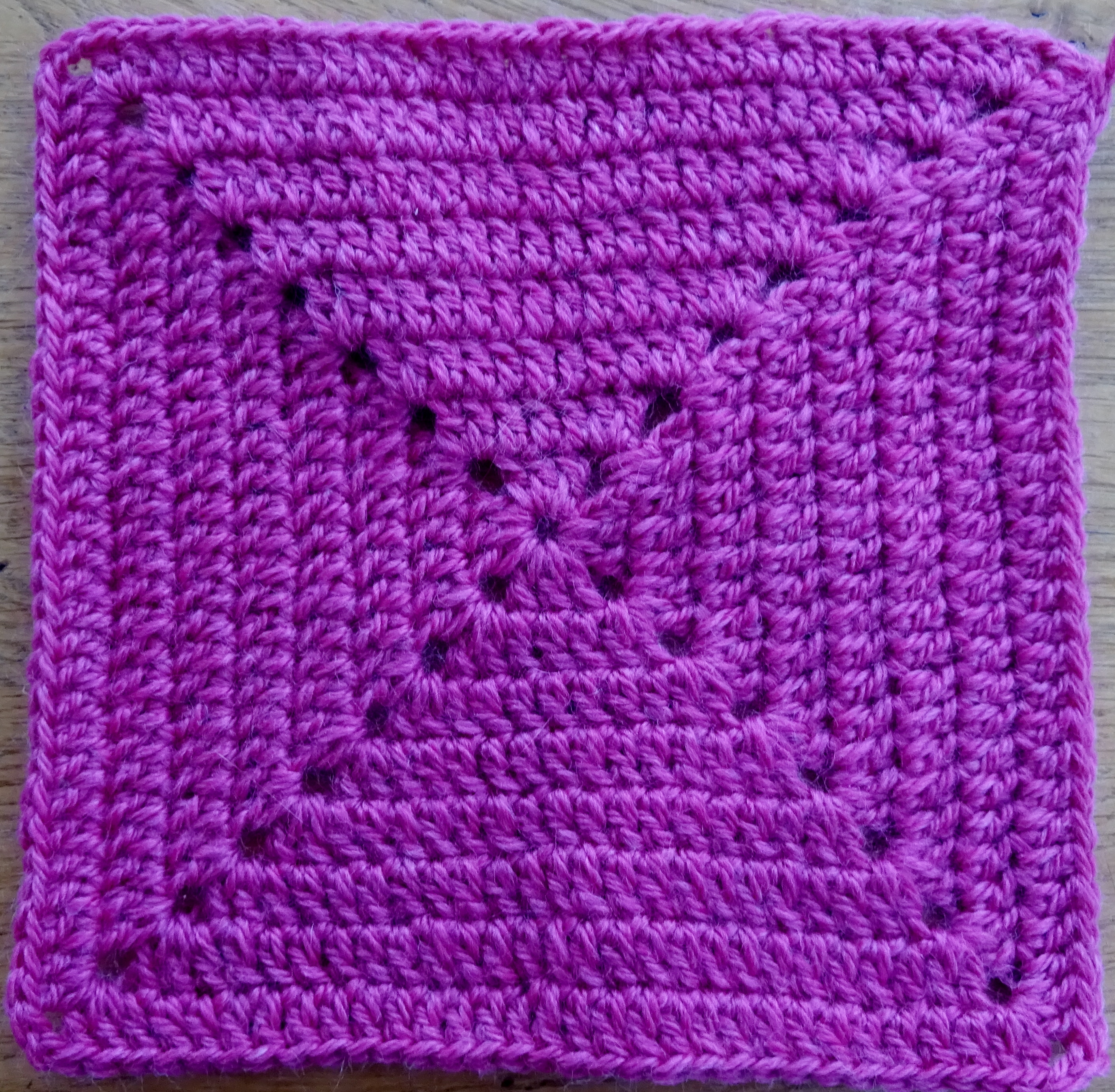
This is the first motif.  It is similar to one I used last year but this has more rounds in total, it’s a ‘solid’ granny square.

ABBREVIATIONS:

The pattern is written in English crochet terms.
St = stitch
Ch = chain
Tr = treble (US dc)
Ss = slip stitch
Sp = space
Ch-sp =chain space

Solid motif
Solid motif

I made 8 of these in a variety of colours:

Foundation:  Make a 4ch foundation ch and join into a ring with a ss

Round 1: 5ch (counts as 1tr, 2ch), (3tr, 2ch) 3 times into the ring, 2tr into the ring, join to 3rd st of first 5ch with a ss.

Round 2: ss into 2ch-sp, (note for this and each subsequent round: this ss is to position the start of the round in the right place) 5ch (counts as 1tr, 2ch), 2tr into the same 2ch-sp, 1tr into each tr along each side and (2tr, 2ch, 2tr) in each 2ch-sp on the corner, finish with 1tr in the first 2ch-sp where you started the round and join to 3rd ch from start with a ss. You should have 7tr along each side and 2ch in each corner of your motif.

Rounds 3 to 8: Repeat Round 2.  Each round the number of tr along each side will increase by 4, so at the end of Round 8 you should have 31tr along each side and 2ch in each corner of your motif.

Break yarn and fasten off leaving a long tail about 3m long for sewing or crocheting together later.

COLOUR

In my sample blanket I made 8 of these motifs in just one colour each.   But you can use up to 8 colours, just by changing colour at the start of each round.  I will start my CAL blanket later today and I’m planning on using at least 2 colours on each of my 8 motifs.  I’ll post progress photos tomorrow.

LAYOUT

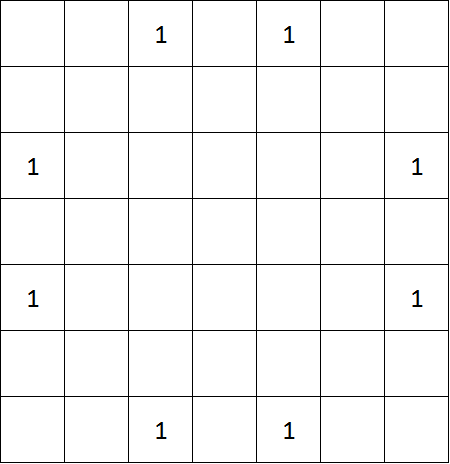
The ‘solid’ motifs can be positioned anywhere in the blanket but I thought it would help to give structure to the blanket if I positioned them around the edge of it.  So here is where I put them in my blanket (shown as 1):

Solid motif locations

If you want to chat about this, there is a discussion thread on my Ravelry forum here.

Or you could just comment on this post.

I’m looking forward to seeing what yarns you choose 🙂

Until tomorrow…..

Happy crocheting xxx

Anniversary Mandala Cushion CAL – the reveal!

I’ve just published the full and final pattern for the anniversary CAL.  So here’s the reveal:

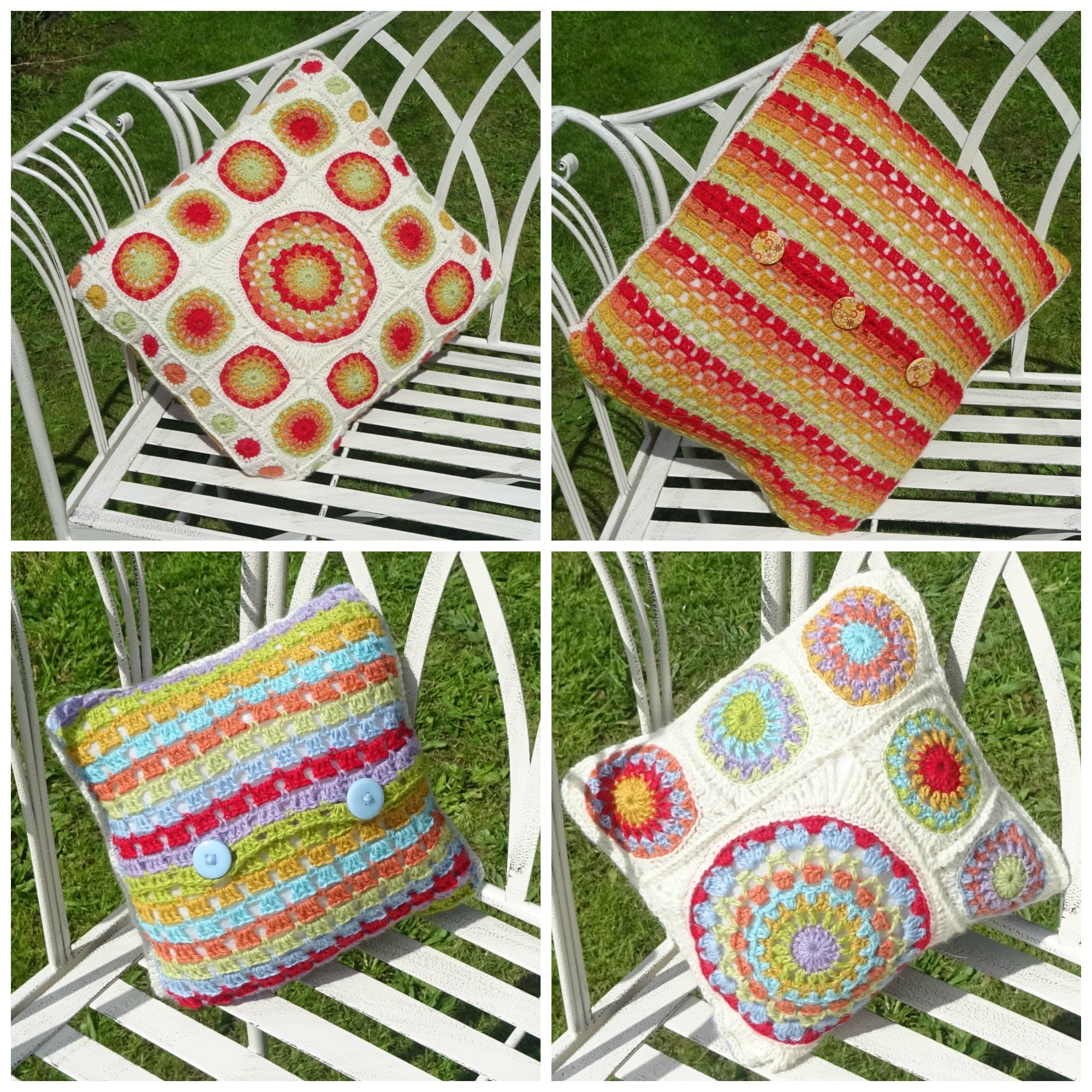
Anniversary mandala cushion

As you can see, the front and back of the cushions I made are different, as I like a little variety.  Of course, if you make a cushion you could make the front and back the same…….but which would you choose?

The full pattern is now on Ravelry, Lovecrochet, Etsy and Craftsy and is now full price.   But there’s still time to join in the CAL on the Ravelry forum 🙂

Happy crocheting xx


A round up!

The last few posts on this blog have been about the Anniversary CAL, but I have been doing a lot more than just finalising the pattern for the CAL.  Patterns are generally written well ahead of publication, then tested and refined – the publication hasn’t taken much of my time at all.

So today I will share a round-up of activity from the last few weeks.

First I was happy to have 2 designs published in different magazines both of which were released on the same day!  What a very happy co-incidence!   Again these were prepared and written months ago, but the excitement of receiving the magazines and seeing the designs in print (and beautifully styled) is immense.  And, of course, I give myself plenty of time to read the magazines over a cup or 2 of coffee!

The first item is the Lariat Belt I designed for Inside Crochet, issue 68. 

Lariat Belt
Lariat Belt

This one is a flexible design – it can be a skinny scarf, a lariat necklace or a belt – the perfect item to pack for holiday.   It is made in some of my favourite yarn, WillowKnits handdyed worsted silk, and it is relatively quick to make, so even if you are off on holiday next week I am sure you can make this in time.

The second design is a retro Boho Top for Mollie Makes, issue 56.

Boho Top
Boho Top

I had such fun making this!  It comes in 2 sizes and I designed it so it is made in one piece and requires very little sewing up.  I know that finishing a crocheted or knitted garment is generally one of the most disliked tasks, and I know of many pieces that languish in cupboards and drawers awaiting sewing up.   For the boho top the motifs are joined as you go and the bodice is made upwards from the motif section, the edging is incorporated into the bodice as you make it and there are probably less than a dozen sewing stitches required to  join the shoulders.    So once you finish hooking it takes minutes to finish the garment!

You may recall I mentioned a while ago that I treated myself on the spur of the moment to a set of Hamanaka crochet hooks from Janie Crow.   I had my eye on these for a while, they looked small and neat, and being double ended meant that I could carry a large range of hooks in a small bag.  They haven’t disappointed me at all.   I haven’t used anything else since I bought them!

I bought a set of 5 regular sizes, a set of 3 small sizes and a small case for them.   The hooks are lovely to handle and, for my small hands, a perfect size.   I added a small pair of scissors, some tapestry needles and stitch markers to the front pocket in the case and I now have a perfect little crochet kit.

Hamanaka - heaven in a hook!
Hamanaka – heaven in a hook!

I have been working on a simple granny square cushion in lovely handdyed 4 ply silk, and you can tell from this photo that I have used the hook a lot (evidenced by the dye accumulating on the handle near the hook shank – don’t worry, I know from experience that this will wash off easily).

Another thing I like about these hooks is that the 3mm and 4mm sizes are on the same hook, and these are the sizes I use the most – so if I want to travel light with crochet, that is the only hook I need carry.

I’ve also been indulging in some more mandala designing, this is a special mandala which is just in the pattern writing stage:

The special
The special

And I have been making some ‘mini bunting’ from a pattern by Emma Lamb published in Mollie Makes Crochet, another great selection of crochet patterns.  This now adorns the headboard of the spare bed.  Previously my Anniversary Crochet Flower mini bunting adorned the bedhead but I felt it was in need of a refresh and a narrower colour palette – 2 of Emma’s flowers from the book were perfect for this.

Mini flower bunting
Mini flower bunting

So what has been keeping you busy this last month?

Happy crocheting xx

Part 2…

Today part 2 of the Anniversary CAL is published.   You can find it on Ravelry and LoveCrochet.

Part 2 has a new motif – a large one!   And it is included in this mini cushion I made:

DSC00890

As you can see the 2 motifs work together well, I designed the sizes so that they did!  Part 2 of the pattern includes a suggested layout if you’d like to make a blanket or throw with just these 2 styles of motif, but there are plenty of other options available – just use your imagination (and maybe a little maths!).

If you haven’t already joined in the CAL, please do – I love seeing what everyone makes with the motifs.

Happy crocheting xxx


Introduction to the Anniversary CAL

I am pleased to announce details of the Anniversary CAL 2015.

It is motif based and mandala inspired – so definitely colourful!

MCAL tiny peek
MCAL tiny peek

The pattern will be released in 3 parts and will be available on Ravelry and on LoveCrochet/LoveKnitting.  Part 1 will be published on 31st July and parts 2 and 3 follow at weekly intervals.

The motifs can be used together in just about any project using whatever yarn you like (stashing busting is very appropriate!).  I am making a cushion with mine, but I would love to see other uses – a blanket, a scarf or whatever you like.   As it is mandala inspired you may even like to make a set of mandalas!

The pattern costs £3.  However, on publication on 31st July I will release a coupon code for those purchasing on Ravelry – the first 10 people using the coupon code will be able to get the pattern free.   Once those coupon codes are used up the pattern will be automatically discounted on Ravelry by £2 for the first week and £1 for the second week.  These discounts will also apply on LoveCrochet/LoveKnitting, which will be handy for those of you purchasing yarn.

There will be a prize draw at the end of September, all finished projects published on the FO thread on Ravelry will be eligible for the prize draw – whatever the FO is!    Multiple entries will be allowed.  Prizes TBA in due course.

If you want to make a cushion then this is the yarn I used (but this isn’t compulsory!):
Drops Alpaca, 100% alpaca, 50g/164m/182yds per ball.  1 ball each of:
Goldenrod (2923), Red (3620), Orange (2915), Lime (7300) and Off White (Main colour) (0100)
3.0mm (US D/3) crochet hook
My cushion had a different front and back, if you want to have them the same you may need 2 balls of the Main Colour.

Any questions?  Join my Ravelry group and ask questions here: Agrarian Artisan 

Happy crocheting xx

Coming soon…….

I have been working on a new design, a stash busting cowl.  Or rather an all round stash buster 🙂

I had a lot of double knit in a variety of rainbow colours so I designed a square motif which I put into a lovely colourful cowl.  I love the motif and I think it is a little addictive.  It would be perfect in a blanket.

The pattern is currently in test but should be published by the end of the week, meanwhile here’s a sneaky peek:

Stash buster
Stash buster

Do you have any ideas to share for stash busting?

Happy crocheting xxx