Spring Lifter CAL final part

This blog post shows you how to finish your bag.  It’s a bit long, but it isn’t difficult.  So please just take the time to read it and then begin the final stage.

First you need to strengthen the top edge of the bag, then you need to add handles.  I did all of this in double crochet (US single crochet).

I am using English crochet terms – check back here if you need reminding what there are.

Here is how I did it:
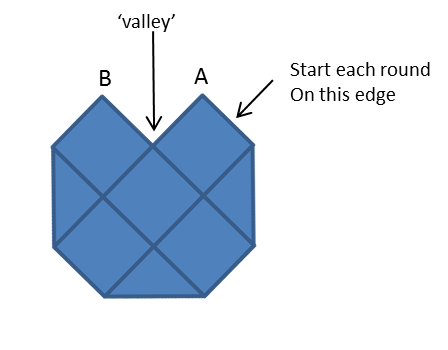
The diagram below shows one side of the bag.   Start each round at the point indicated by the arrow on this diagram.
granny tote side

The first 2 rounds strengthen the top edge.
Round 1:  Using Yarn D (mine was Pastel Green), work 1 round of double crochet, place 1dc in each tr or 1ch-sp along the edges.  At the top corners of the squares (Points A and B)   put 3 dc into each 2ch-sp and place a stitch marker into the middle of these 3dc.  At the ‘valleys’ work 3dc together.  Join the round with a ss.
Round 2:  work another round of dc, working 1dc into each stitch around.  At point A.   put 2dc into the stitch marked, remove stitch marker and replace into the first of these 2 dcs.  At the valleys, work 3dc together.  At point B, put 2dc into the stitch marked, remove stitch marker and replace into the second of these 2 dcs.  Repeat with points A and B on the second side.
Join the round with a ss, break yarn and fasten off.

Now you’ll make the handles.
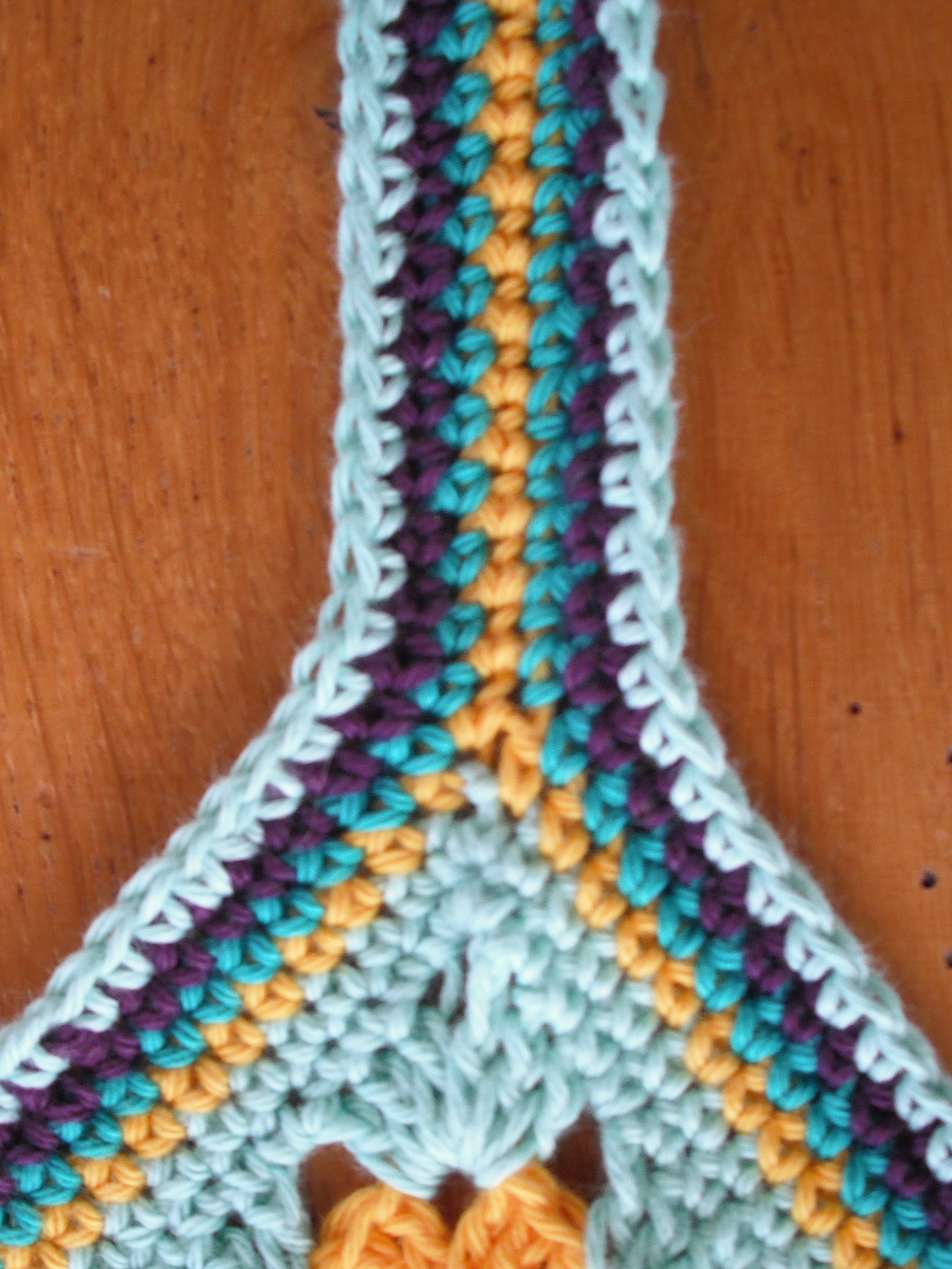
Handles
Handles

Round 3:  Join yarn C (mine was Canary yellow) at the point shown in the diagram, work 1dc into each stitch up to and including the first stitch marker at point A, *move stitch marker to next dc along at point A, work 80ch, then miss all stitches between points A and B and work 1dc into stitch marked at point B (these 80ch will form the handle – you may wish to make them longer or shorter, so just check that you are happy with the length before continuing), work 1dc in each stitch down from point B, work 3dc together at the next valley**, work 1dc in each st up to the next point A and repeat the instructions from * to **, finally work 1dc in each st back to the start, join with ss, break yarn and fasten off.

That was the tricky bit – now you will work the top edges of the handles.
Round 4: join yarn B (mine was Sea green), work 1dc in each st around, working 3dc together in the valleys.  Break yarn and fasten off.
Round 5:  Join yarn A (mine was Heath), work 1dc in each st around, working 3dc together in the valleys.  Break yarn and fasten off.
Round 6:  Join yarn D (mine was Pastel green), work 1dc in each st around, working 3dc together in the valleys.  Break yarn and fasten off.

The final stage is to work the inner edges of the handles (the edges between points A and B that you left unworked on round 2) – there are 2 of these and you work both of them the same as follows:
Rejoin Yarn C (canary yellow) to the first stitch marker (the one you moved at point A), work 1 round of dc, placing 1dc in each st or the underside of the (canary yellow) chain of the handle, and working 3dc together in the valley.   Now work 3 more rounds of dc – in yarn B, then yarn A, then yarn D (remember to work 3dc together in the valley).

You may find that you want to add more rows of dc to make the handles larger.  Mine were perfect for my use.

You may wish to personalise your bag, and there are lots of ways you can do this. I made a little flower with a Dorset button in the centre.
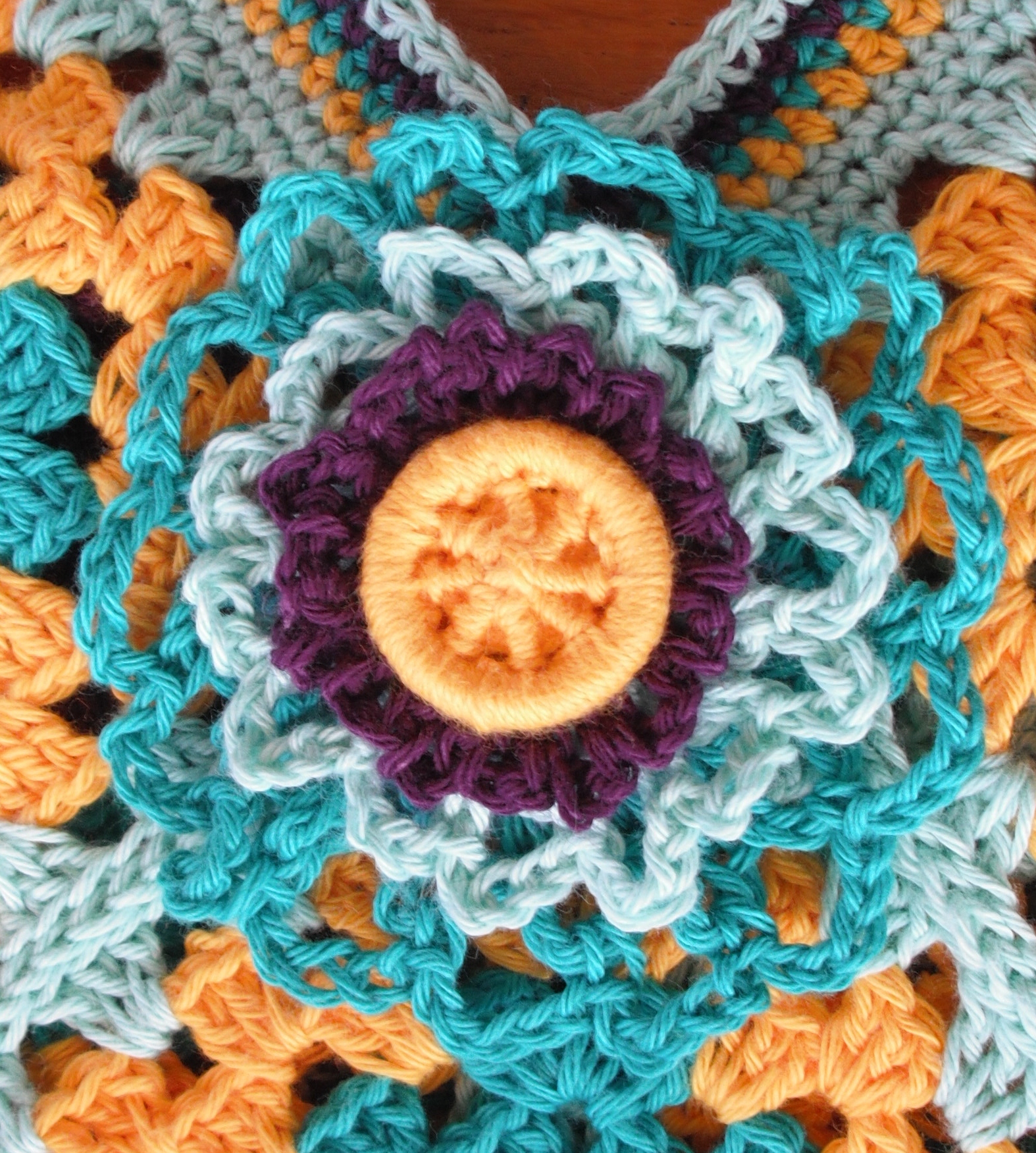
Dorset button flower

First make a Dorset button – there are some excellent instructions here. I made mine in canary yellow.

Now make a simple flower.  I used this motif pattern:
Foundation ring:  make a 4ch foundation and join into a ring with a ss
Round 1: 2ch (counts as 1htr), 14 htr in ring, join to 2nd ch from start with a ss. (15htr)
Round 2: 4ch (counts as 1dc, 3ch), *1dc in next st, 3ch; repeat from * to last st, 1dc in last st, 1ch, 1htr in 1st ch from start (forming the last 3ch-sp). (15 3ch-sps)
Round 3: 6ch (counts as 1dc, 5ch), *1dc in next 3ch-sp, 5ch; repeat from * to last 3ch-sp, 1dc in last 3ch-sp, 2ch, 1tr in 1st ch from start (forming the last 5ch-sp). (15 5ch-sps)
Round 4: 6ch (counts as 1dc, 5ch), *1dc in next 5ch-sp, 5ch; repeat from * to end of round join to 1st ch from start with a ss.  Break yarn and fasten off.

To construct the flower, make 3 different sized motifs in different colours.
One using the first 2 rounds (I used Heath).
One using the first 3 rounds (I used Pastel green).
One using all 4 rounds (I used Sea green).

Place the motifs on top of each other, place the Dorset button on top of all 3 and sew together.  Then sew to the bag.  And voila – the bag is made!

Zingy spring lifter
Zingy spring lifter

Of course, you could personalise your bag in any way you like, add a lining, lengthen or shorten the handles, add  buttons, flowers – anything!   Whatever you do, please show me what you make on my Ravelry forum.

Happy crocheting xx

Spring Lifter CAL part 2

This week I’m going to show you how to turn the motifs into the bag shape.  Here’s a reminder of the bag, so you know the shape you are aiming for:

Zingy spring lifter
Zingy spring lifter

First you need to block them.   If you leave it until you finish the bag you may find it a bit tricky.

Then you need to decide how you are going to join them.  I recommend joining in one of these 4 ways:

  1. By slip stitch holding the motifs right sides together, as I did for the Christmas CAL here.
  2. By double crochet (US single crochet) holding the motifs wrong sides together.
  3. By sewing.
  4. By slip stitch holding the motifs side by side, this is the method I used and I worked into the back stitch only.  You may find this a bit tricky if you haven’t done it before, but I think it gives a good effect and is worth that extra effort.  This shows you the technique:
Slip stitch side by side back loops only

And the finish:

Joined
Joined

I joined my bag using the same yarn that I used for the last round of my motifs – the Pastel Green.

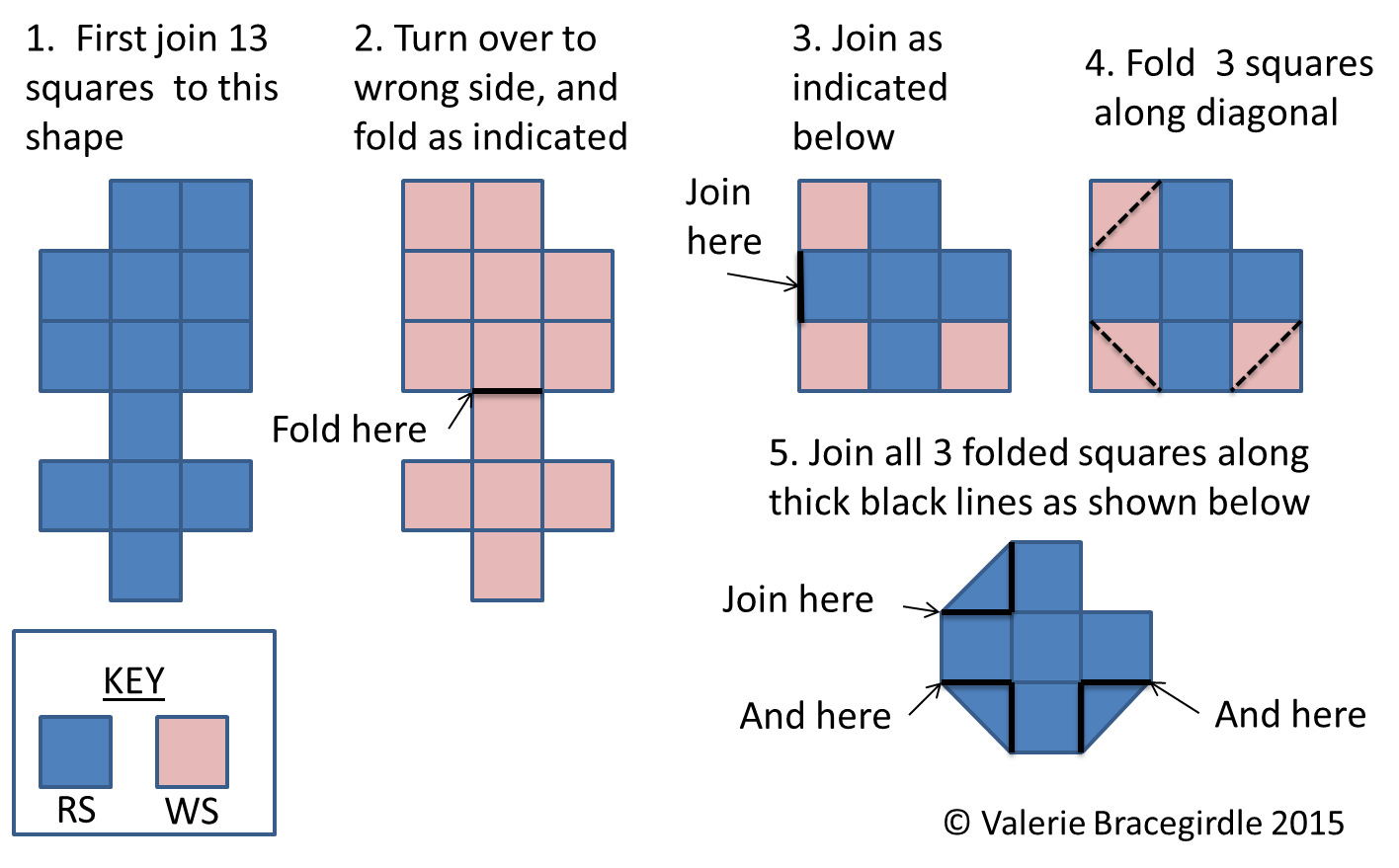
To form the bag shape you need to join them in a particular order.  And I have illustrated this in the following diagrams:

Granny Tote Joining
Granny Tote Joining

It will take a while for you to make you bag shape, and you may find the last bits a little tricky.  So I will share how to finish your bag next week.

Keep posting progress and asking questions on my Ravelry forum.

Happy crocheting xx

Spring Lifter CAL part 1

I’m going to make this CAL relaxed and slow – so you will get 3 weekly instalments and, hopefully, will have plenty of time each week to complete the instalment.

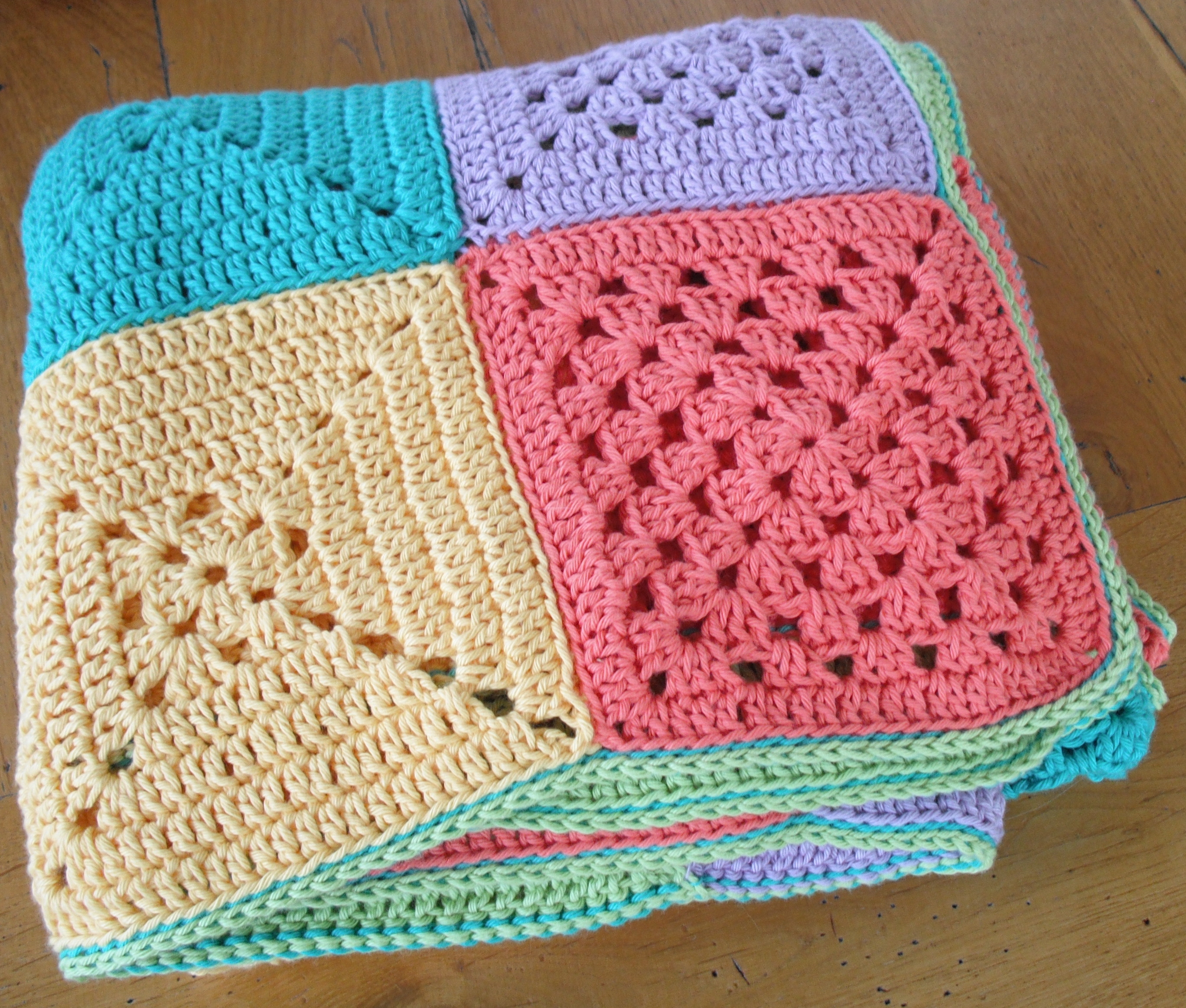
At the end of 3 weeks you should have a lovely bag like this

Ok – are you ready to start?

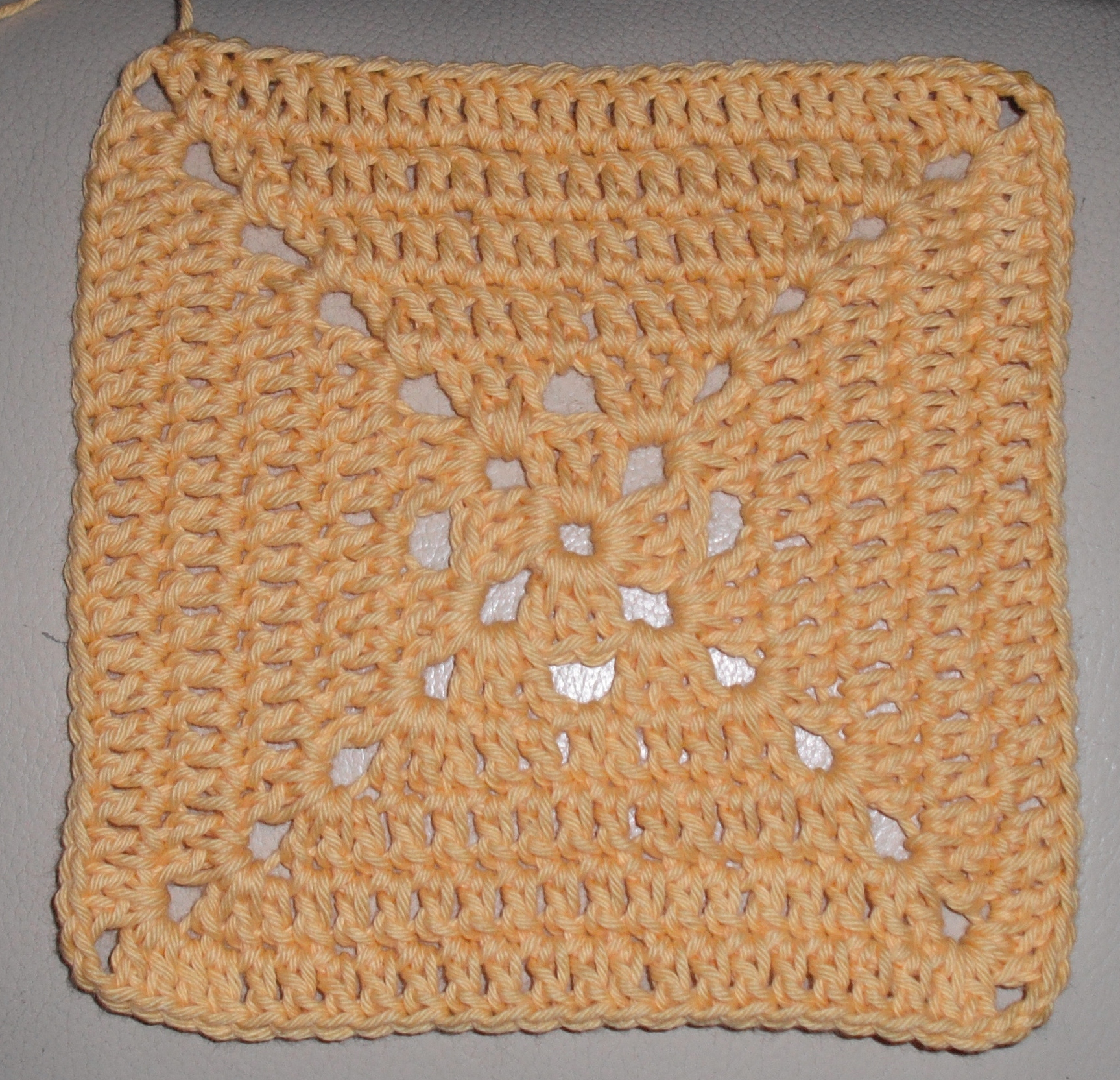
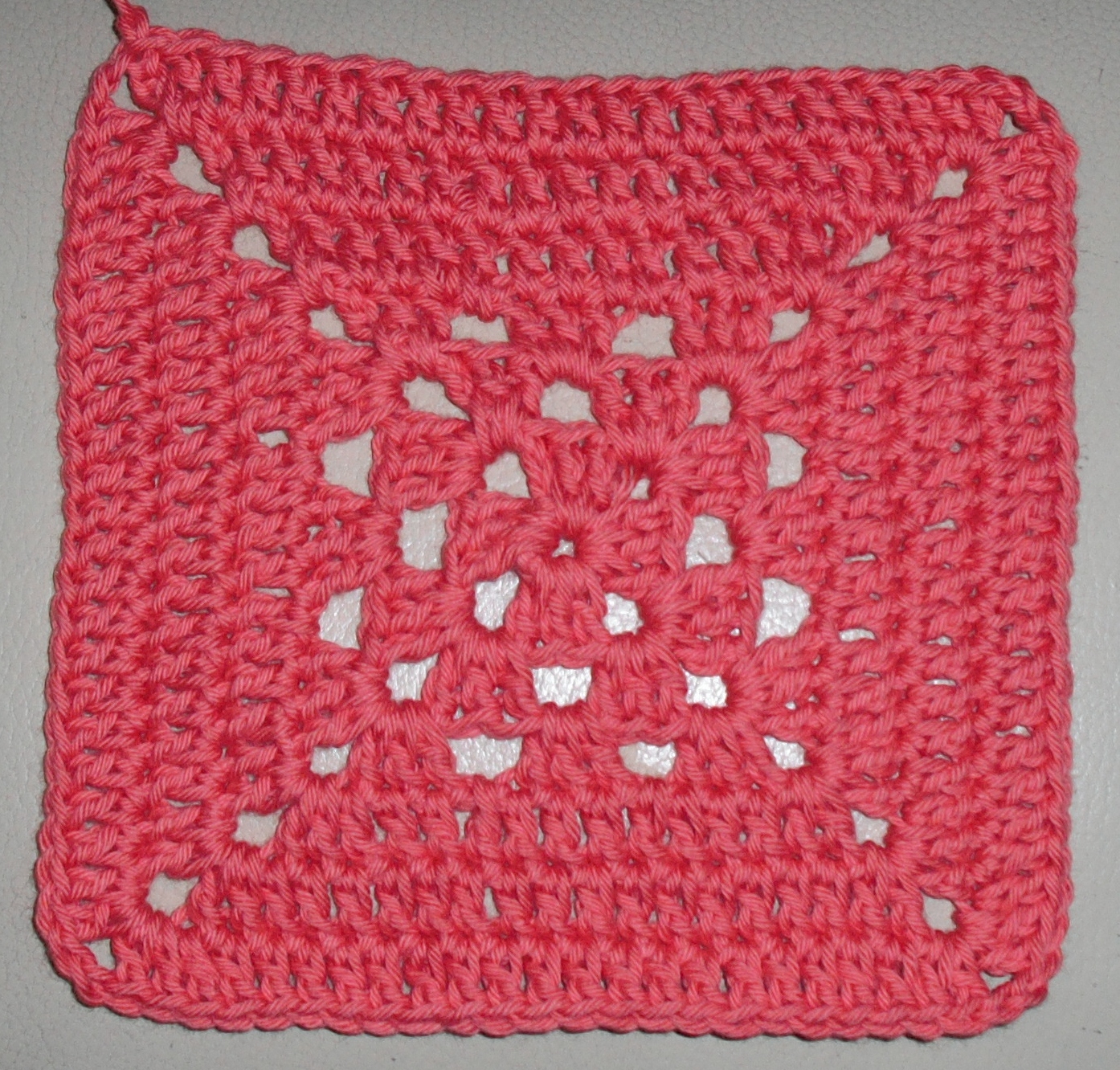
You will need 13 Granny Squares each about 15cm/6″ square.  I used a traditional granny square and the pattern I use is written below – but you may use whatever granny pattern you like.  Using my pattern and 4ply cotton yarn and a 3mm hook I ended up with 7 rounds (just a little smaller than 15cm/6”).

If you are using different weight of yarn you may wish to do fewer or more rounds and, of course, you may choose any colour scheme you want.

A quick reminder of my yarn colours: A is Heath (deep purple), B is Sea Green, C is Canary (yellow) and D is Light Pastel Green.

ABBREVIATIONS
The pattern is written in English crochet terms.
St = stitch
Ch = chain
Tr = treble (US dc)
Ss = slip stitch
Sp = space
Ch-sp =chain space

7 round granny square

Foundation:  Using Yarn A, make a 4ch foundation ch and join into a ring with a ss
Round 1: 5ch (counts as 1tr, 2ch), (3tr, 2ch) 3 times into the ring, 2tr into the ring, join to 3rd st of starting 5ch with a ss.
Round 2: ss into 2ch-sp, (note for this and each subsequent round: this ss is to position the start of the round in the right place) 5ch (counts as 1tr, 2ch), (3tr, 1ch) into the same 2ch-sp, (3tr, 2ch, 3tr, 1ch) into each of the next three 2ch-sps, 2tr into the first 2ch-sp, join to 3rd st of starting 5ch with a ss. Break yarn and fasten off.
Round 3: Using Yarn B, ss into 2ch-sp, 5ch (counts as 1tr, 2ch), (3tr, 1ch) into the same 2ch-sp, *(3tr, 1ch) into the next 1ch-sp, (3tr, 2ch, 3tr, 1ch) into the next 2ch-sp; repeat from * another 2 times (3tr, 1ch) into the next 1ch-sp, 2tr into the first 2ch-sp, join to 3rd st of starting 5ch with a ss.
Round 4: ss into 2ch-sp, 5ch (counts as 1tr, 2ch), (3tr, 1ch) into the same 2ch-sp, *(3tr, 1ch) into each of the next two 1ch-sps, (3tr, 2ch, 3tr, 1ch) into the next 2ch-sp; repeat from * another 2 times (3tr, 1ch) into each of the next two 1ch-sps, 2tr in the first 2ch-sp, join to 3rd st of starting 5ch with a ss. Break yarn and fasten off.
Round 5: Using Yarn C, ss into 2ch-sp, 5ch (counts as 1tr, 2ch), (3tr, 1ch) into the same 2ch-sp, *(3tr, 1ch) into each of the next three 1ch-sps, (3tr, 2ch, 3tr, 1ch) into the next 2ch-sp; repeat from * another 2 times (3tr, 1ch) into each of the next three 1ch-sps, 2tr into the 1st 2ch-sp, join to 3rd st of starting 5ch with a ss.
Round 6: ss into 2ch-sp, 5ch (counts as 1tr, 2ch), (3tr, 1ch) into the same 2ch-sp, *(3tr, 1ch) into each of the next four 1ch-sps, (3tr, 2ch, 3tr, 1ch) into the next 2ch-sp; repeat from * another 2 times (3tr, 1ch) into each of the next four 1ch-sps, 2tr into the 1st 2ch-sp, join to 3rd st of starting 5ch with a ss.  Break yarn and fasten off.
Round 7: Using Yarn D, ss into 2ch-sp, 5ch (counts as 1tr, 2ch), (3tr, 1ch) into the same 2ch-sp, *(3tr, 1ch) into each of the next five 1ch-sps, (3tr, 2ch, 3tr, 1ch) into the next 2ch-sp; repeat from * another 2 times (3tr, 1ch) into each of the next five 1ch-sps, 2tr into the 1st 2ch-sp, join to 3rd st of starting 5ch with a ss. Break yarn and fasten off, leaving a long tail of about 3m for sewing or crocheting together later.

Tune in for the next stage, which I’ll publish in a week.

I have a discussion thread on my Ravelry Group here.   Please join in and share your progress.

Happy crocheting xx
My Spring Lifter!

Here is what I have been making this week:

Zingy spring lifter
Zingy spring lifter

It is in zingy colours and is lifting my mood, making me think of Spring even though we are still in Winter here in the UK.  I have seen similar bags but never attempted to design one like this before, it was easier than I imagined it would be!  So I thought you might like me to share how I made this with you.

I will be posting 3 blogs on the ‘how to’.

If you want to join in you may wish to start gathering your equipment now.

I made my ‘spring lifter’ in a 4ply/fingering weight cotton in a chosen colour scheme.  However this can be made in any yarn weight and would be a fabulous stash buster.  Remember if you use a different yarn weight you should use a suitable hook size.

So here is what I used:

YARN
Scheepjes Cotton 8, 50g/170m/186yds per ball.  I used 4 colours:
A – 1 ball of Heath (721) – a deep purple
B – 1 ball of Sea Green (723)
C – 2 balls of Canary (714) but I used only about 5m/yd of the second ball
D – 1 ball of Light Pastel Green (663)

HOOK
3mm crochet hook (US D/3)

OTHER
4 lockable stitch markers
Tapestry needle for sewing ends
Ring for Dorset button (optional) for the centre of my simple flower.

Start gathering your equipment and I’ll post part 1 of the ‘how to’ tomorrow.

Meanwhile, I have started a discussion on my Ravelry forum here, if you want to join in this CAL please join in the discussion too.  I’d love to see what you make.

Happy crocheting xx

New Year, New Project

I’m embarking on a new project, something using the traditional granny square.

New granny
New granny

I am using some cotton 4 ply/fingering weight yarn which I haven’t used before – Scheepjes Cotton 8.  It is lovely to work with and when I started to use it I got carried away with just making some grannies, they fly off my hook!  So I have a little production line going:

Grannies growing
Grannies growing

What am I making?  You’ll just have to wait and see!

Happy crocheting xx
Christmas CAL final part – THE BIG REVEAL!

Happy New Year!  I hope you celebrated the turn of the old year in suitable style.

Today is the big reveal!

First I will explain my edging.  I wanted something simple.  In fact when I had joined my motifs I liked the look of the blanket so much that I almost didn’t do an edging.  But not doing an edging is a crochet sin!  All blankets need something firm along the edge to hold the whole shape.

I experimented with several ideas and settled for the simplest.  I expect you think I did a double crochet edging, this is simple isn’t it?  Well I didn’t.  The simplest edging is slip stitch, and I did 2 rounds of slip stitch.

To maintain the same effect that I achieved with the joining of the motifs, the slip stitch edging was done into the back loop only.  This leaves the front loop of each motif to ‘frame’ the motif.  So the first edging round was done into the back loop of every stitch along the sides (that works out at 25 per motif edge).

Edging first round
Edging first round

Once you have completed the first round you will find the blanket has a nice firm edge.  Actually I think this simple round give a good finish, but I wanted a little more.

The second round went into the back loop of the first round.  When the second round is complete you’ll see that only the front loop of the first round is showing.  So choose your colours carefully as the second round is the predominant colour.

Edging second round
Edging second round

I didn’t do any extra stitches in the corners, I don’t think it necessary when it is just 2 rounds of slip stitch.  And it creates a gentle curve at the corner.

Edging corner
Edging corner


Nicely edged
Nicely edged

And this is the final blanket in it’s glory, being inspected by @yarnaddictcat :

@yarnaddictcat inspection

No little embellishment have been added (yet!).

If you look very closely you may notice that I didn’t quite follow the layout plan.  The colours are the same but the motifs are slightly off plan.  This is because, as I mentioned in part 4, I was running out of some colours so adjusted the order of motifs I made a little bit.

Now I’ve shown you mine – please show me yours!

Happy crocheting xxxx


Now for the legal stuff – I designed this, it’s all my own work and is copyright. Please feel free to make as many as you like, but not for commercial purposes, and please credit me with the design. Thank you!


Christmas CAL part 6

Happy New Year’s Eve!

I have finished my blanket now, but I will save the big reveal until New Year’s Day.  Today I am sharing my little embellishment.

If you have been reading this blog for the last week or so you will know that I had my idea for the little embellishment only a few days ago.   I thought a small flower would look lovely in the centre of some of the squares:

Embellishment
Embellishment

Regular blog readers may recognise this flower, it is the Anniversary Crochet Flower that I designed and published here.  I used one colour for the first 2 rounds, then swapped to a different colour for the last round.  I think it is perfect as a little embellishment.

Embellishment 2
Embellishment 2

What do you think?   Maybe you should wait until your blanket is joined and edged before making these, as you don’t want to run out of yarn!  But you can practice on some scraps, as these little flowers don’t use too much yarn.

Flowerf field
Flower field

I still haven’t decided whether to add them to my blanket (hence the long tails haven’t been cut off yet as they will be needed for sewing on),  I think my blanket zings already………..decisions, decisions…….

Tune in tomorrow for the final part and THE BIG REVEAL!

Happy crocheting xxxx


Now for the legal stuff – I designed this, it’s all my own work and is copyright. Please feel free to make as many as you like, but not for commercial purposes, and please credit me with the design. Thank you!

Christmas CAL part 5

I am feeling pretty happy today, I have joined all my motifs and I love the way the blanket looks.  The colours are bright and fresh, and I have decided this will be my garden throw/picnic rug – it zings!

Today I am sharing my ideas for layout and how to join.

Let’s start with the joining.

I have opted for a very straightforward joining that doesn’t leave a ‘ridge’ on the front of the blanket. This is my preference, you may choose to join any way you like.

Remember I said to leave a long tail of about 3m at the end of each motif pattern?  Well I use that long tail to join the motifs.  Hold the motifs front sides together and slip stitch through the back loops of both motifs along the edges using the long tails.

Joining by slip stitch

Using the back loops means that the front loops of each motif are still visible on the front side along the edges making a nice straight edge where the motifs lie next to each, like this:

Front of join
Front of join

You can get a similar effect by sewing together using the back loops as well.

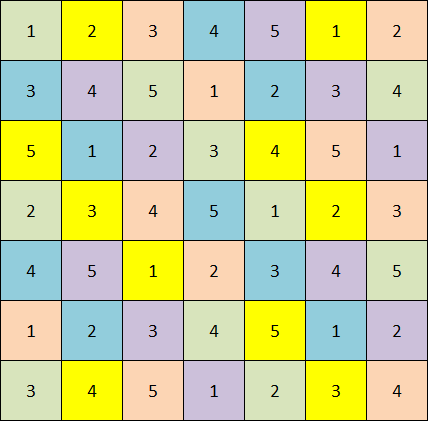
The layout of the blanket is 7 motifs by 7 motifs.  The following diagram shows how I planned my layout.

First the key:

Full Motif is no 1

Granny 2 motif is no 2

Granny 3 motif is no 3

Granny 4 motif is no 4

Granny 5 motif is no 5.

The colours are pretty obvious!

Layout 1
Layout 1

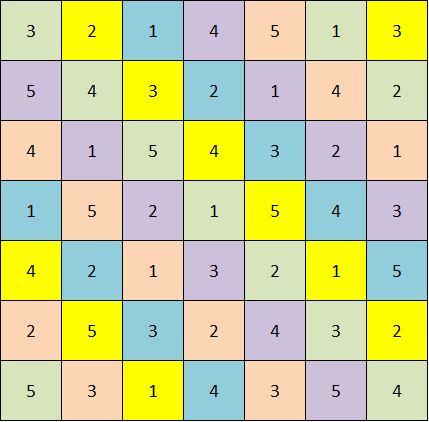
In my layout the colours are sort of random but there is a regularity to the motif style.  If you prefer the colours to be more regular then the following is an alternative:

Layout 2
Layout 2

You don’t have to follow either of these layouts, but I hope they give you some inspiration on how to make your blanket.

Tomorrow I will show you my little embellishment.  I haven’t decided whether to use it on my blanket, but we’ll see!

As always please share your progress on my Ravelry group here, and you can ask any questions on there (I know joining can be tricky).

Happy crocheting xxx


Now for the legal stuff – I designed this, it’s all my own work and is copyright. Please feel free to make as many as you like, but not for commercial purposes, and please credit me with the design. Thank you!

Christmas CAL part 4

Today I finished my final square.  Phew!  Only just ahead of you all….this spontaneous CAL has been a lot of fun and has kept me busy over the Christmas season.  It is lovely to be able to say I made a blanket in this short time.

My promise for today was to publish the final 2 motifs, so here we go……

Here’s the usual reminder of the ABBREVIATIONS:

The pattern is written in English crochet terms.

St = stitch

Ch = chain

Tr = treble (US dc)

Ss = slip stitch

Sp = space

Ch-sp =chain space

This GRANNY 2 MOTIF, I am making 10, 2 of each of my colours:

Granny 2 motif
Granny 2 motif

Foundation:  Make a 4ch foundation ch and join into a ring with a ss

Round 1: 5ch (counts as 1tr, 2ch), (3tr, 2ch) 3 times into the ring, 2tr into the ring, join to 3rd st of first 5ch with a ss.

Round 2: ss into 2ch-sp, (note for this and each subsequent round: this ss is to position the start of the round in the right place) 5ch (counts as 1tr, 2ch), (3tr, 1ch) into the same 2ch-sp, (3tr, 2ch, 3tr, 1ch) into each of the next three 2ch-sps, 2tr into the first 2ch-sp, join to 3rd st of starting 5ch with a ss.

Round 3: ss into 2ch-sp, 5ch (counts as 1tr, 2ch), 2tr into the same 2ch-sp, 1tr into each tr and 1ch-sp along each side and (2tr, 2ch, 2tr) in each 2ch-sp on the corners, finish with 1tr in the first 2ch-sp and join to 3rd ch from start with a ss.  You should have 11tr along each side and 2ch in each corner of your motif.

Round 4: ss into 2ch-sp, 5ch (counts as 1tr, 2ch), 2tr into the same 2ch-sp, 1tr into each tr along each side and (2tr, 2ch, 2tr) in each 2ch-sp on the corner, finish with 1tr in the first 2ch-sp and join to 3rd ch from start with a ss. You should have 15tr along each side and 2ch in each corner of your motif.

Rounds 5 and 6: Repeat Round 4. You should have 23tr along each side and 2ch in each corner of your motif.  Break yarn and fasten off leaving a long tail about 3m long for sewing or crocheting together later.

This GRANNY 4 MOTIF, I am making 10, 2 of each of my colours:

Granny 4 motif
Granny 4 motif

Foundation:  Make a 4ch foundation ch and join into a ring with a ss

Round 1: 5ch (counts as 1tr, 2ch), (3tr, 2ch) 3 times into the ring, 2tr into the ring, join to 3rd st of first 5ch with a ss.

Round 2: ss into 2ch-sp, (note for this and each subsequent round: this ss is to position the start of the round in the right place) 5ch (counts as 1tr, 2ch), (3tr, 1ch) into the same 2ch-sp, (3tr, 2ch, 3tr, 1ch) into each of the next three 2ch-sps, 2tr into the first 2ch-sp, join to 3rd st of starting 5ch with a ss.

Round 3: ss into 2ch-sp, 5ch (counts as 1tr, 2ch), (3tr, 1ch) into the same 2ch-sp, *(3tr, 1ch) into the next 1ch-sp, (3tr, 2ch, 3tr, 1ch) into the next 2ch-sp; repeat from * another 2 times (3tr, 1ch) into the next 1ch-sp, 2tr into the first 2ch-sp, join to 3rd st of starting 5ch with a ss.

Round 4: ss into 2ch-sp, 5ch (counts as 1tr, 2ch), (3tr, 1ch) into the same 2ch-sp, *(3tr, 1ch) into each of the next two 1ch-sps, (3tr, 2ch, 3tr, 1ch) into the next 2ch-sp; repeat from * another 2 times (3tr, 1ch) into each of the next two 1ch-sps, 2tr in the first 2ch-sp, join to 3rd st of starting 5ch with a ss.

Round 5: ss into 2ch-sp, 5ch (counts as 1tr, 2ch), 2tr into the same 2ch-sp, 1tr into each tr and 1ch-sp along each side and (2tr, 2ch, 2tr) in each 2ch-sp on the corners, finish with 1tr in the first 2ch-sp and join to 3rd ch from start with a ss.  You should have 19tr along each side and 2ch in each corner of your motif.

Round 6: ss into 2ch-sp, 5ch (counts as 1tr, 2ch), 2tr into the same 2ch-sp, 1tr into each tr along each side and (2tr, 2ch, 2tr) in each 2ch-sp on the corner, finish with 1tr in the first 2ch-sp and join to 3rd ch from start with a ss. You should have 23tr along each side and 2ch in each corner of your motif.  Break yarn and fasten off leaving a long tail about 3m long for sewing or crocheting together later.

My mind is now turning to edging but first I need to join them all.   I don’t have a lot of yarn left, in fact I have to confess now that I didn’t have a full 2 balls of each colour and I knew I might be a little short of yarn at the end.  But you should have taken my advice and made sure you have at least a full 2 balls of each colour (or 2 x 184m/201yds), so you should have plenty left.

I do want a simple edging and I know I have just enough for that, but you may want to do something more fancy and I know you’ll have enough yarn left to experiment.

Tomorrow I’ll share layout ideas and how to join.

Please keep sharing your progress on my Ravelry group here:

Happy crocheting xxx


Now for the legal stuff – I designed this, it’s all my own work and is copyright. Please feel free to make as many as you like, but not for commercial purposes, and please credit me with the design. Thank you!

Christmas CAL part 3

I’ve been busy today, so I apologise for being a bit late with this post.  My ‘busy’ was a family gathering.  It is always lovely to see the family, especially at Christmas.  And I do enjoy the catering for a crowd, which I don’t do very often.   Perhaps if I catered for a large group more frequently I wouldn’t enjoy it as much!

So now I am ready for some relaxing crochet.   Are you ready for the next motif?    I hope so, because here it is:

First a reminder of the ABBREVIATIONS:

The pattern is written in English crochet terms.

St = stitch

Ch = chain

Tr = treble (US dc)

Ss = slip stitch

Sp = space

Ch-sp =chain space

This is the third motif design, I am making 10, 2 in each of my chosen colours.

I call it the GRANNY 3 MOTIF:

Granny 3 motif
Granny 3 motif

Foundation:  Make a 4ch foundation ch and join into a ring with a ss

Round 1: 5ch (counts as 1tr, 2ch), (3tr, 2ch) 3 times into the ring, 2tr into the ring, join to 3rd st of first 5ch with a ss.

Round 2: ss into 2ch-sp, (note for this and each subsequent round: this ss is to position the start of the round in the right place) 5ch (counts as 1tr, 2ch), (3tr, 1ch) into the same 2ch-sp, (3tr, 2ch, 3tr, 1ch) into each of the next three 2ch-sps, 2tr into the first 2ch-sp, join to 3rd st of starting 5ch with a ss.

Round 3: ss into 2ch-sp, 5ch (counts as 1tr, 2ch), (3tr, 1ch) into the same 2ch-sp, *(3tr, 1ch) into the next 1ch-sp, (3tr, 2ch, 3tr, 1ch) into the next 2ch-sp; repeat from * another 2 times, (3tr, 1ch) into the next 1ch-sp, 2tr into the first 2ch-sp, join to 3rd st of starting 5ch with a ss.

Round 4: ss into 2ch-sp, 5ch (counts as 1tr, 2ch), 2tr into the same 2ch-sp, 1tr into each tr and 1ch-sp along each side and (2tr, 2ch, 2tr) in each 2ch-sp on the corners, finish with 1tr in the first 2ch-sp and join to 3rd ch from start with a ss.  You should have 15tr along each side and 2ch in each corner of your motif.

Round 5: ss into 2ch-sp, 5ch (counts as 1tr, 2ch), 2tr into the same 2ch-sp, 1tr into each tr along each side and (2tr, 2ch, 2tr) in each 2ch-sp on the corner, finish with 1tr in the first 2ch-sp and join to 3rd ch from start with a ss. You should have 19tr along each side and 2ch in each corner of your motif.

Round 6: Repeat Round 5. You should have 23tr along each side and 2ch in each corner of your motif.

Break yarn and fasten off leaving a long tail about 3m long for sewing or crocheting together later.

Tomorrow, yes so soon, I will publish the last 2 motifs.  I know some of you are powering away with your hooks, I can see the smoke from here!  And those of you who haven’t progressed as quickly may like a little variety.

On Wednesday I will share my 2 proposals for layout, suggestions on how to join and my little embellishment.

And on Friday I will give you ideas on edging – mine will be simple.

As always, how you finish your blanket will be up to you, so all my ideas are only here to help inspire you.  I love seeing variations, so please feel free to adapt as you like.

Please share your progress on the discussion thread on my Ravelry Group here.

Happy crocheting xxx


Now for the legal stuff – I designed this, it’s all my own work and is copyright. Please feel free to make as many as you like, but not for commercial purposes, and please credit me with the design. Thank you!